Fillable Maryland Quitclaim Deed Template
The Maryland Quitclaim Deed form serves as a crucial legal instrument for property owners looking to transfer their interest in real estate without the complexities often associated with traditional deeds. This form allows one party, known as the grantor, to convey their ownership rights to another party, the grantee, effectively simplifying the transfer process. Unlike warranty deeds, a quitclaim deed does not guarantee that the grantor holds clear title to the property or that there are no encumbrances. Instead, it operates on the principle of "as is," meaning the grantee accepts the property with any existing claims or liens. This form is particularly useful in situations such as divorce settlements, estate transfers, or transactions between family members. To ensure the deed is legally binding, it must be signed by the grantor in the presence of a notary public and subsequently recorded with the local land records office. Understanding the implications and requirements of the Maryland Quitclaim Deed is essential for anyone involved in property transactions, as it can significantly impact ownership rights and future dealings.
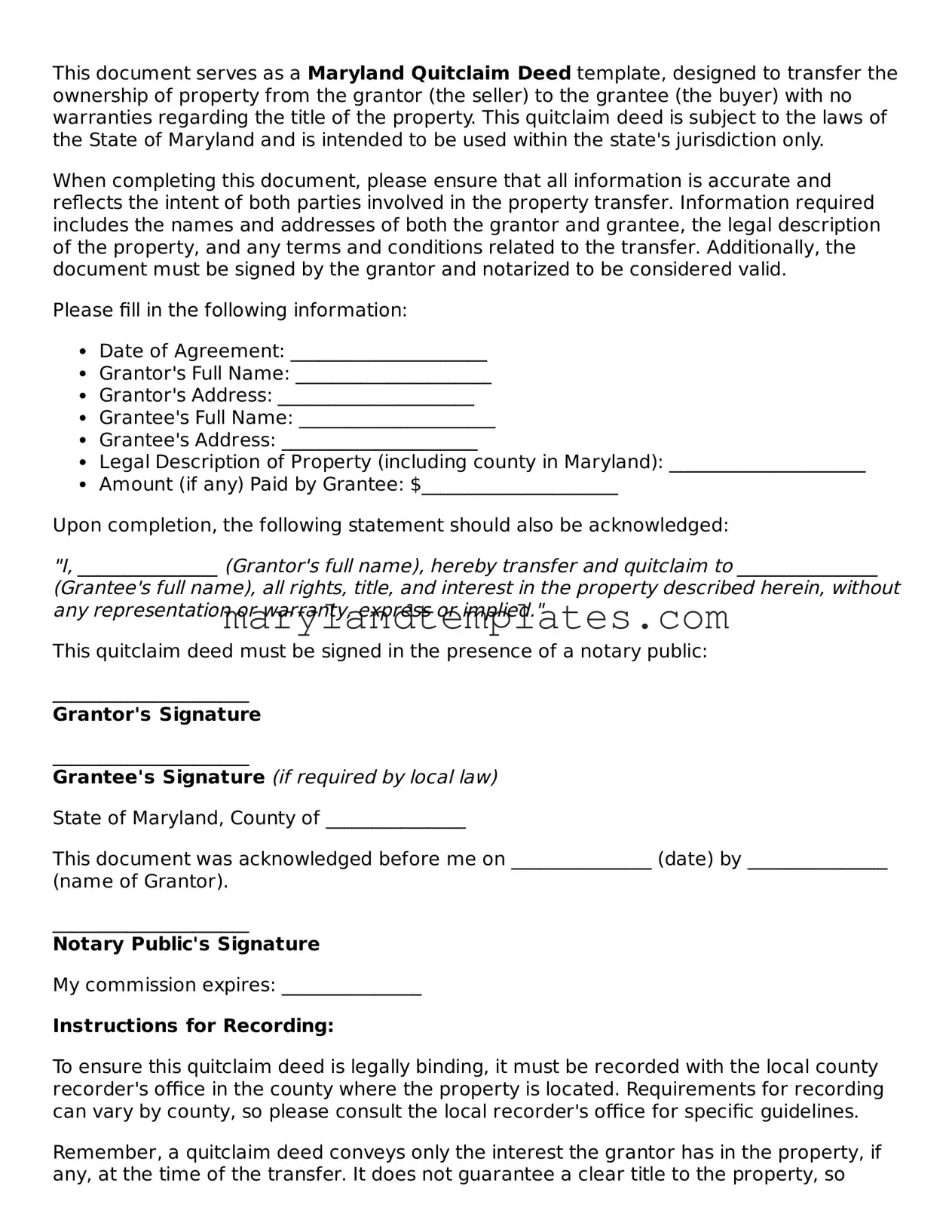
Maryland Quitclaim Deed Preview
This document serves as a Maryland Quitclaim Deed template, designed to transfer the ownership of property from the grantor (the seller) to the grantee (the buyer) with no warranties regarding the title of the property. This quitclaim deed is subject to the laws of the State of Maryland and is intended to be used within the state's jurisdiction only.
When completing this document, please ensure that all information is accurate and reflects the intent of both parties involved in the property transfer. Information required includes the names and addresses of both the grantor and grantee, the legal description of the property, and any terms and conditions related to the transfer. Additionally, the document must be signed by the grantor and notarized to be considered valid.
Please fill in the following information:
- Date of Agreement: _____________________
- Grantor's Full Name: _____________________
- Grantor's Address: _____________________
- Grantee's Full Name: _____________________
- Grantee's Address: _____________________
- Legal Description of Property (including county in Maryland): _____________________
- Amount (if any) Paid by Grantee: $_____________________
Upon completion, the following statement should also be acknowledged:
"I, _______________ (Grantor's full name), hereby transfer and quitclaim to _______________ (Grantee's full name), all rights, title, and interest in the property described herein, without any representation or warranty, express or implied."
This quitclaim deed must be signed in the presence of a notary public:
_____________________
Grantor's Signature
_____________________
Grantee's Signature (if required by local law)
State of Maryland, County of _______________
This document was acknowledged before me on _______________ (date) by _______________ (name of Grantor).
_____________________
Notary Public's Signature
My commission expires: _______________
Instructions for Recording:
To ensure this quitclaim deed is legally binding, it must be recorded with the local county recorder's office in the county where the property is located. Requirements for recording can vary by county, so please consult the local recorder's office for specific guidelines.
Remember, a quitclaim deed conveys only the interest the grantor has in the property, if any, at the time of the transfer. It does not guarantee a clear title to the property, so conducting a thorough title search before the transaction is highly advisable.
Form Specifications
| Fact Name | Description |
|---|---|
| Definition | A quitclaim deed is a legal document used to transfer ownership of real estate without guaranteeing that the title is clear. |
| Governing Law | The Maryland Quitclaim Deed is governed by the Maryland Real Property Code, specifically Title 3, which addresses deeds and conveyances. |
| Parties Involved | The deed involves two main parties: the grantor (the person transferring the property) and the grantee (the person receiving the property). |
| Consideration | While not always required, a nominal consideration, such as $1, is often included to validate the transfer. |
| Title Guarantee | Unlike warranty deeds, a quitclaim deed does not provide any guarantees about the title. The grantee accepts the property "as is." |
| Recording | To protect the grantee's interest, the quitclaim deed should be recorded with the local land records office in Maryland. |
| Uses | Quitclaim deeds are commonly used among family members, in divorce settlements, or to clear up title issues. |
| Legal Advice | It is advisable to seek legal counsel when drafting or signing a quitclaim deed to ensure that all legal requirements are met. |
Additional Maryland Templates
Maryland Homeschool Required Subjects - Establishes a formal record of homeschooling intent, which may be referenced in future educational or legal contexts.
To ensure that your sensitive information remains protected, consider utilizing the resources available at WA Documents, where you can easily access the necessary forms and guidance for drafting a comprehensive Non-disclosure Agreement tailored to your needs.
Hold Harmless Clause California - In sports and recreational facilities, participants are often required to sign a Hold Harmless Agreement to use the facilities.
Non Compliant Id Maryland - By carefully selecting the powers granted within the form, vehicle owners can maintain control over their asset while delegating routine or complex tasks to their agent.